

Seating Policy
For safety reasons, we cannot accommodate late admission OR re-seating while the performance is in progress.
Run Time
This production runs
90-minutes and is presented without intermission.
Contents & Effects
This play includes descriptions of physical abuse and use of gunshot sound effects, strobe, and water-based vape haze.
Photos
& Video
Photos and recording of any kind is not allowed during the show.
Program Contents
The articles in this program are the opinions of the corresponding authors.
Production
Credits
LAND
ACKNOWLEDGEMENT
We recognize that Stanford sits on the ancestral land of the Muwekma Ohlone Tribe. This land was and continues to be of great importance to the Ohlone people. Consistent with our values of community and inclusion, we have a responsibility to acknowledge, honor and make visible the university’s relationship to Native peoples.
Our Sponsors
This production was made possible through the generous support of the PIGOTT FUND FOR DRAMA and the MAY ELLEN RITTER PRODUCTION FUND.
ARTISTIC TEAM
Director/Playwright
Lucas Baisch
Faculty Advisor
Branislav Jakovljević
Co-Scenic Designer
Lucas Baisch
Co-Scenic Designer
Alyssa Aviles
Scenic Design Advisor
Nina Ball
Costume Designer
Ezra Melosh
Costume Design Advisor
Becky Bodurtha
Lighting Designer
Connor Lifson
Associate Lighting Designer
Raina Yang
Lighting Design Advisor
Christian Mejia
Sound Designer
Ilan Salomon-Jacob
Sound Design Advisor
Becky Bodurtha
Video/Projection Designer
Casey Manning
Dramaturg/Assistant Director
Kaelani Rae Burja
Stage Manager
Noah Jun Murase
Stage Management Advisor
Virginia Tipps
CAST
SLACK
César Valenzuela
RO
Karla Stephanie Osnaya Roman
CAMEO
Mikey Mendoza
TAPS STAFF
Department Chair
Jisha Menon
Artistic Director
Amy Freed
Director of Finance & Operations
Eugene Buck
Asst. Director of Finance & Operations
Wenlin He
Student Services Manager
Katie Dooling
Finance & Faculty Affairs Admin
Janet Pineda
Production Manager
Tyler B. Osgood-Sheaffer
Technical Director
Beckett Finn
Costume Shop Lead
Heather Miller
Scenic & Technology Lead
Brett Cavanaugh
Head Electrician
Kenny McMullen
Head Cutter/Draper
Emma Vossbrink
Head Carpenter
Zach Sigman
Production Associate
Stephanie Manno
Theatrical Technicians
Mari Camacho Leyva, Austin Critchlow, Logan D’Arcey, Joseph Krempetz, Christina Lange, Tiffany Leyva, Paul Strayer, James Tinsley, Sid Zhang
Costume Technicians
Courtney Morgan, Lauren Suiter, Linda Wu, Kyo Yohena
Scenic Painter
Cristina Anselmo
Facilities Manager
Lori Fowler
Director of Marketing & Special Events
Stefanie Okuda
Marketing & Special Events Coord.
Brendon Martin
Production Photographer
Frank Chen
TAPS STUDENT STAFF
Student Costume Shop Admin
Angelica Alvarado
Student Costume Technicians
Maicy Lee-Jones, Ezra Melosh, Annika Parmar
Student Scenic Technicians
Bonnie Dong, Shayla Fitzsimmons-Call, Kyan Gandhi, Maya Hausman, Vivi LaFont, Yisong Lin, Arya Martin, Noah Murase, Noah Rinke, Liana Singh, Jude St John, Kate Stewart, Yasmine Toubassy, Raina Yang, Sophie Zeng
Student Costume Administrator
Charlotte Kearns
Student Props Loan Out Coordinator
Eli Romero Ortigosa
Student Assistant Production Managers
Nic Chesterman, Iamanni Jackson
Student Asst. Facilities Manager
Sawyer Williams
Props Loan Out Coordinators
Lela Hanson, Roberto Ibarra, Da-Hee Kim, Eli Romero Ortigosa
Costume Loan Out Coordinator
Da-Hee Kim, Rebecca Spence
A Note from
the Director
LUCAS BAISCH
TAPS graduate student
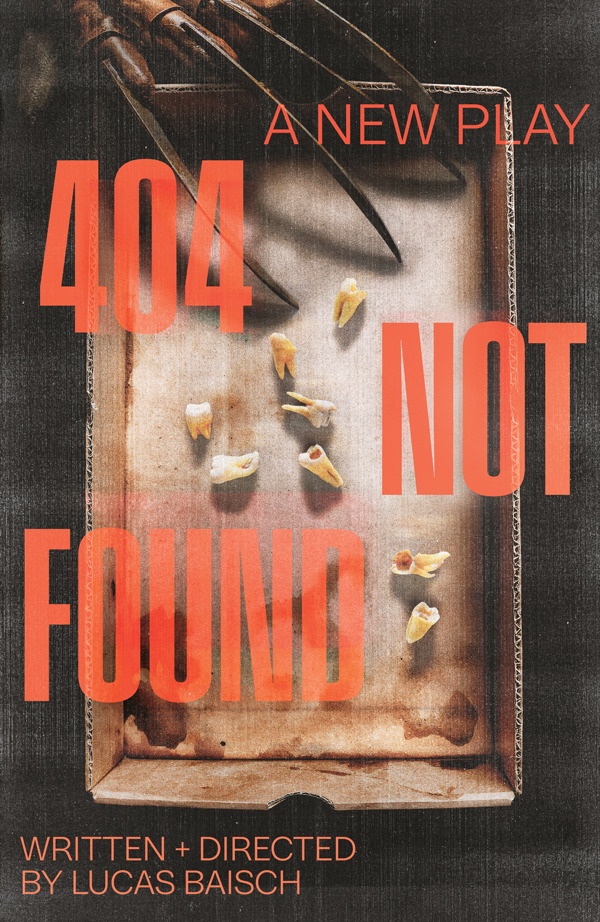
In 2000, I was home alone with my two older brothers. Wes Craven’s New Nightmare (1994), the seventh film in the Nightmare on Elm Street franchise, was playing on our box television. I was immediately struck by the vision of Fred Krueger, the lacerated boogeyman who haunts the dreamscape of the film’s defenseless suburban youth. Here began a decades-long contract with the fictional mascot of my sleeping life: “you can stay here, but you can’t hurt me,” I told him.
I wrote this play six years ago, late at night, sitting in the kitchen of my apartment in Providence, RI. I’d just finished my MFA, and the global pandemic stalled any notion of a daily ritual. I’d spent the first months of this new reality alone, and the psychic dregs of my persistent insomnia carved fertile ground for Krueger to regain his creep. At the same time, the apparatus of the American theatre showed signs of deterioration. George Floyd was brutally murdered. My days were spent ingesting online discourse on cultural inequities — voices trumpeting violence received and violence expelled.
I rewatched the entirety of the nine-film franchise. In its 1984 inception, Reagan had just been re-elected. Studies of Vietnam War veterans’ post-traumatic dreams were gaining prominence. Horror films reinforced the punishment of teenage sexuality. Somewhere in my marathon viewing, I saw an analogue for my growing distrust of authority. I wanted to investigate my orientation within the mythos of Latinidad. I wanted to synthesize the painful disappearance of an ambient public. My play speared through me like a hallucinogenic skyscraper.
In 2026, I revisit the work’s form, wondering how eruptive language, punctuation’s markings, and absences on the page might spur physicality. What gesture slicks forth from a sentence’s disjuncture, the awkward preposition or missing article, the clunk of a noun-turned-verb? How can this alternative grammar signal a resistance to normative speech, and in turn, normative psychologies? In 2026, a rehearsal conversation helps our ensemble define the play’s mechanics of time travel: 1) you have to sacrifice some nearby life force to achieve a brief grazing with the past, 2) this stolen moment is a source of great pleasure, and 3) you do not get to stay there.
The nondescript suburban heartland in Craven’s films mirrors the quiet of both the Californian Central Valley and regional Central America that my play inhabits. These idyllic spaces can often evade temporal stampings, that is, until the monster materializes. Horror builds through patterns of tension and release. In 2026, an anxious climate has burgeoned alongside the expanding footprint of detention and the proliferating machinery of state violence that makes people disappear. While my characters push against authority, fortifying their fantasies, I wonder what happens when monstrosity usurps their individual sanctuaries. In part, 404 Not Found is a love letter to a film series that enraptured me in my adolescence. In another, it asks how we attempt to craft utopia when erasure becomes a primary condition of life.
Director's
Thanks
This play could not have existed without developmental support from the John F. Kennedy Center for the Performing Arts, the National New Play Network, Millay Arts, New Dramatists, and 53rd State Press.
This production owes great thanks to Tyler Osgood-Sheaffer, Beckett Finn, my intrepid cast and creative team, my TAPS PhD colleagues, production staff and faculty advisors, as well as the beautiful delinquents of my life who have inspired this gangly playworld.
About
the Artists
LUCAS BAISCH (Director/Playwright; Co-Scenic Designer) is a third-year TAPS PhD student from San Francisco. His plays have been developed at the Goodman Theatre, the Playwrights’ Center, Magic Theatre, First Floor Theater, Mercury Store, Playwrights Horizons, Ars Nova, Bard College, etc. His work has been published by Bloomsbury, Theater Magazine, and 53rd State Press. He is a recipient of the Steinberg Playwright Award, the Princess Grace Award, and a Jerome Fellowship. MFA: Brown University, Playwriting.
ALYSSA AVILES (Co-Scenic Designer) is a multidisciplinary artist and arts educator based in San Francisco, CA. Her work draws from personal and historical archives to build an iconography of place and memory, and is largely influenced by generations of lineage in San Francisco’s Mission District. Formally trained as a printmaker, Alyssa integrates print media and techniques across painting, sculpture and installations using found objects. Alyssa is currently pursuing her MFA in Art Practice at Stanford University.
KAELANI RAE BURJA (Dramaturg/Assistant Director) is a first-year TAPS PhD student from Tamuning, Guam and Bakersfield, California. She is ecstatic to be working on her first TAPS production, especially this thrilling new work centering Latinidad. Kaelani has worked as a dramaturg and assistant director on various Off-Broadway, regional, operatic, and touring productions across the US and spent the past two years in Europe devising original works at the National Theatre of Malta.
MELODY DING (TAPS 39 Crew) is a sophomore double-majoring in TAPS and Comparative Literature. Previously at Stanford, she acted in TAPS’s 찜질방 (Minji) and Moonchild (Lyra), as well as participated in AATP’s Yakada Yaka (Cast; Assistant Electrician). This year, Melody is Co-Artistic Director of AATP and will be acting in Theater Lab’s we’re still seeing shadows (Kizzie) and staged reading of The Tournament.
CONNOR LIFSON (Lighting Designer) is a director and designer of theater. His work has been presented at the Edinburgh Festival Fringe, the Wuzhen Theatre Festival, Lookingglass Theatre Company, the San Francisco International Arts Festival, and Witch Hunt Theatre. At Stanford, where he is currently a PhD Candidate in TAPS, he has directed Moonchild (2026) and Omelas (2024) and will be directing Angels in America, Part I: Millennium Approaches this winter. He is a co-founder of Moon Dog. ConnorLifson.com
EZRA MELOSH (Costume Designer) (he/they) is a junior majoring in TAPS and FemGen. Previously at Stanford, he has designed for Moonchild (Costume Designer), Arsonists (Assistant Costumes), and Waiting for Magnapinna (Costume Designer).
MIKEY MENDOZA (CAMEO) (he/him) is a Junior majoring in Mechanical Engineering. He was previously involved in TAPS’s Three Sisters (Laundry), Witch (Laundry), Fun Home (Laundry), Arsonists (Laundry), and Romeo and Juliet (Laundry); Theater Labs Proportionality (Danny) and Wink (SM).
NOAH JUN MURASE (Stage Manager) is a sophomore currently undecided. He is involved as a designer with Asian American Theater Project, Ram’s Head Theatrical Society, and the Stanford Shakespeare Company.
KARLA STEPHANIE OSNAYA ROMAN (RO) (she/her) is a junior studying Psychology with various interests spanning the philosophy and education fields. Loves horror movies, dancing, and long walks. This is her first TAPS production at Stanford. She is excited to see where her path leads her next.
ILAN SALOMON-JACOB (Sound Designer) (he/him) is a second-year master’s student at the Center for Computer Research in Music and Acoustics (CCRMA).
CÉSAR VALENZUELA (SLACK) is a storyteller and PhD candidate in Philosophy at Stanford. César’s work as a writer and director creates dialogues between political philosophy, performance, and film. Before coming to the Bay Area in 2019, they practiced as an actor, poet, and editor in a variety of artistic projects in Caracas and Paris. Recent theater productions include Proportionality (Nitery, 2025) and Twinks in Caracas: An Oil Fantasia (Nitery/Et al. etc. Gallery, 2026).
RAINA YANG (Associate Lighting Designer) is a Junior double-majoring in Electrical Engineering and TAPS. Previously at Stanford, she was involved in TAP’s Moonchild (LD) 찜질방 (jjim-jil-bang) (LD) bed (LD) Arsonists (ALD). Ram’s Head’s Legally Blonde (LD), 50 Shades of Grayeties (LD), Gaieties: Camp Stanford (SM), and AATP’s Matilda The Musical (LD).